So often we speak of emotional "baggage" as something undesirable, something to be left behind, abandoned. Recently, I have found myself rethinking that.
No one is free of regret…or innocent of mistakes. We are taught to "put our past behind" us…but in some ways, that might be leaving something vital out of the mix. Our past mistakes, bad experiences, poor choices and regrettable decisions are as much a part of us as the color of our eyes.
The "baggage" does not go away because we leave it behind…it follows us quietly and sorrowfully through life. Don't get me wrong, I don't think we should drag along the pain, anger, anxiety that these things cause. Rather, that we should embrace that part of ourselves with love and forgiveness…and OWN our part in it. Only by doing so can we learn to see the lessons those experiences offer.
I believe we are drawn to certain people (or types of people) because they have something to teach us about ourselves. What do we miss learning about ourselves when we try to erase a relationship because we, as the song says, "went down that wrong road again"?
It is easy to lump the pain and regret all onto someone else and burn the bridge between you, but sometimes that fire also consumes all the good that came into your life with that person. No matter how badly something ended…it always began with something beautiful.
Our mistakes do not, by default, define us. We CHOOSE what to define ourselves by. Some allow themselves to be defined by their tragedies…others define themselves only by their successes. To be whole, I believe we should choose neither…but rather live in harmony with our failures and in humility with our successes. It is in that balance that we find peace.
Wandermuse
One artist's journey: Trying to live a creative life with grace, grit, gratitude...and a border collie.
21 January 2020
08 October 2019
Fox Me a Copy, 2019
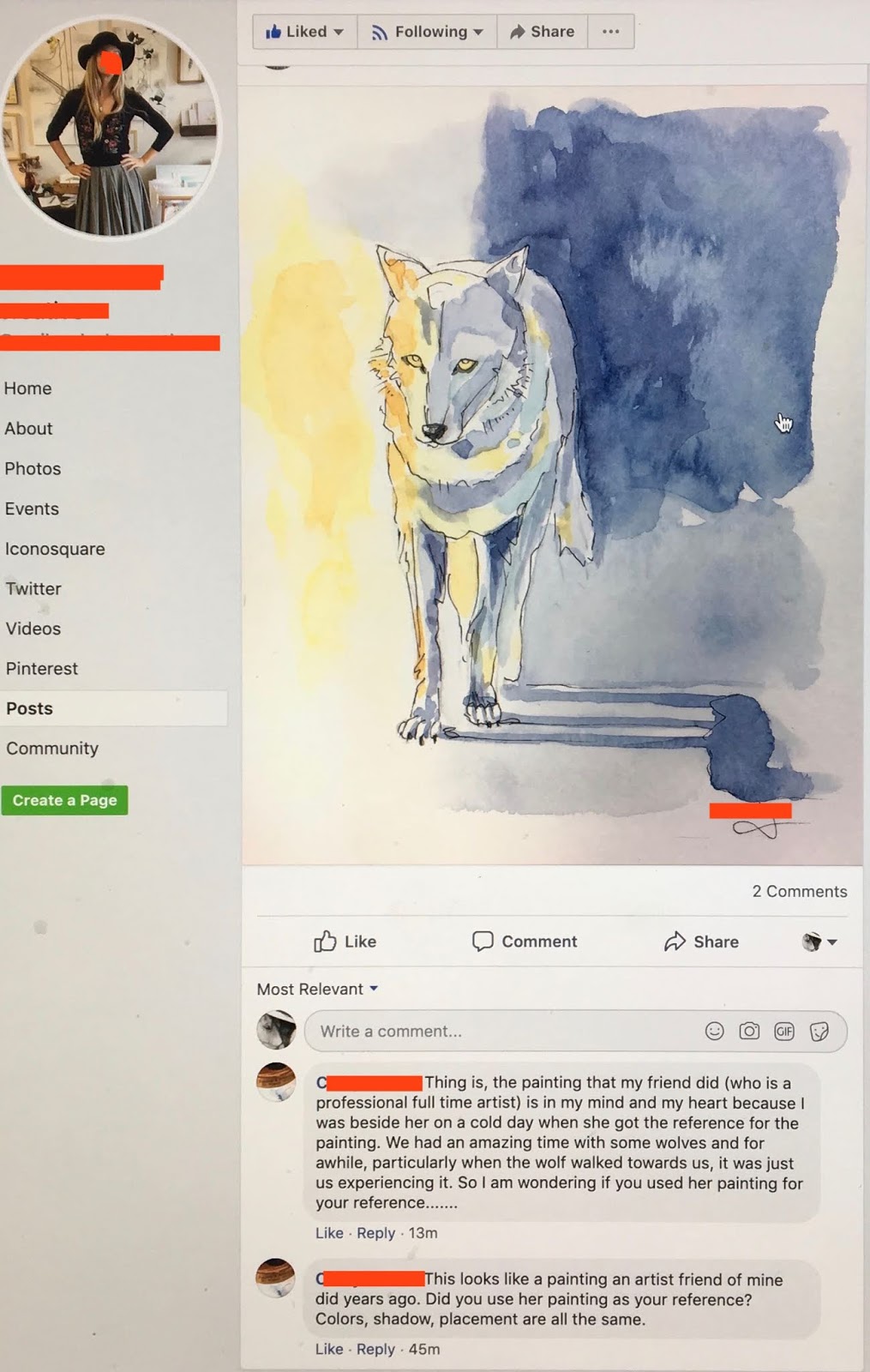
Last night I was alerted to an artist's post on Facebook...and I immediately recognized my own painting: same composition, same complimentary blue/yellow color choices, same shadow, same position of the animal, same abstract block of blue in the background...even the same exposed toenails.The big difference was that, because I actually watched this animal in the wild, my wolf has only one tail, not two.
This is the original from my page. >
When confronted by a comment from one of my collectors, this person claimed that she often used "copyright-free" images from the internet as reference.
Note that "Copyright Lyn StClair" is posted right in the middle of the image. The person just ignored the posted copyright.
Guess it is time to add this incident to my post about copyright and re-share...
In the Fall of 2012, I debuted this painting of a fox titled "Grasshopper" at a show in Georgia...
<
A week later, at a little art show in Nashville...
I discovered a copy of my painting: >
The conversation went something like this:
Lyn: "Your fox painting looks familiar"
(Copycat): "Yes, I was inspired by your use of color"
Lyn: "It is exactly the same"
(Copycat): "Oh no, the pose of the fox is COMPLETELY different"
That, and seeing copies of work by other artists hanging in his booth, was the conversation ender. I picked up his card, photographed the copy and contacted my attorney.
As I was taking a photo of his copy (he'd even copied my framing!), a customer walked in, looked at his piece and exclaimed..."Wow! That is what I love to see, a completely original work of art!" When I showed her the image of my original painting on my iPad and replied "it is a copy of my painting", she shrugged and took a photo of his painting.
Originality…what is it made of? As artists, we strive for originality in a world that makes copying "okay". There are knock-offs of everything you can imagine being sold on street corners, online and in stores everywhere. What has happened to us? Where did we lose the appreciation for true originality? Artists are admired and revered for their originality…but what about the ones who copy other artists? Why do some people choose to copy the work of others? Is it laziness, a lack of integrity, or simple ignorance? Is it possible they just don't know any better?
Throughout the history of art, artists have learned to paint by copying one another or other people's photos. The comic books that many artists grew up with (my Dad and I included) had adverts on the back asking kids to "Draw Me!", copy a drawing in the ad to send in to their "scholarship" competition. For centuries, students of art have stood with easels and sketchbooks in front of the art of masters (old and new)…to learn by copying every brushstroke. Heck, I started my professional career after copying a lovely portrait by Betty StClair (she's my Mom…and she said I could).Copying as a tool to learn is one thing…
Where does it cross the line into "theft", though?
First, let's get the dry stuff out of the way...a little about the legalities of copyright.
According to the U.S. Copyright Office/Library of Congress:
"Copyright is a form of protection provided by U.S. law to authors of “original works of authorship,” including “pictorial, graphic, and sculptural works.” The owner of copyright in a work has the exclusive right to make copies, prepare derivative works, sell or distribute copies, and display the work publicly. Anyone else wishing to use the work in these ways must have the permission of the author or someone who has derived rights through the author."
"A work is automatically protected by copyright when it is created, that is, “fixed” in a copy or phonorecord for the first time. Neither registration in the Copyright Office nor publication is required for copyright protection."
"Before March 1, 1989, the use of a copyright notice was mandatory on all published works, and any work first published before that date should have carried a notice. For works first published on or after March 1, 1989, use of a copyright notice is optional."
As per that last paragraph: Just because a painting or photograph does not have "copyright" on it…it does NOT mean it is free to use!!!
For visual artists…copyright of every original image belongs to the creator of that image (this includes photographs). That means you may not copy a work of art (or photo) without express, written permission of the original creator. To put it bluntly, if you copy a painting, sculpture or photograph created by anyone other than yourself without written permission: it is stealing, plain and simple. By the way, it goes for writing, as well.
What if you"change" it…where does it become "safe" or "derivative"? Here again, words from the Library of Congress:
"A “derivative work” is a work based upon one or more preexisting works, such as a translation, musical arrangement, dramatization, fictionalization, motion picture version, sound recording, art reproduction, abridgment, condensation, or any other form in which a work may be recast, transformed, or adapted. A work consisting of editorial revisions, annotations, elaborations, or other modifications which, as a whole, represent an original work of authorship, is a “derivative work”."
Copyright law takes a narrower view, defining “derivative work” as “a work based upon one or more preexisting works, such as a translation, musical arrangement, dramatization, fictionalization, motion picture version, sound recording, art reproduction, abridgment, condensation, or any other form in which a work may be recast, transformed, or adapted.” (17 U.S.C. § 101)
This is important because one of the rights given by law to copyright owners is “to prepare derivative works based upon the copyrighted work.” 17 U.S.C. § 106. That means the original creator of a work has the exclusive right to produce derivative work…anyone else has to have the permission of the creator. Even Hollywood cannot make a movie of a book without obtaining the " rights" from the author…the same goes for photographs and paintings!
As artists, we often find "inspiration" in the works of others. Where is the line drawn between "inspired by" and "stealing from"? "Fair Use" is a defense available to someone who uses the work of someone else—without permission—in the creation of (his or her) own. "Fair Use" does not mean "okay to copy"! This is what the U.S. Copyright office says about Fair Use:
"The doctrine of fair use has developed through a substantial number of court decisions over the years and has been codified in section 107 of the copyright law. Section 107 contains a list of the various purposes for which the reproduction of a particular work may be considered fair, such as criticism, comment, news reporting, teaching, scholarship, and research. Section 107 also sets out four factors to be considered in determining whether or not a particular use is fair."
Fair use is a slippery slope, though… the court's interpretation of those four factors is subjective and can bring unpredictable results. You may think your use is fair, the original creator and the court may well think otherwise.
Essentially, if someone recognizes any similarity between your work and the original:
then you're in trouble.

A few simple rules to remember:
* If you didn't create it yourself, someone else did…and it belongs to THEM!
* It does not matter if you are selling it or just using it for your own purposes.
* Just because it is on the internet…it is NOT free to use.
* Just because millions of other people are doing it…NO!
Consider the partial image of the elk painting in the screen shot, you can see she mimicked my idea even in that painting...contrasting blues and golds, abstract darks in the background, long shadow (though, the shadow is on the wrong side based on the light). While that may not be entirely ethical, is not infringement.
Now to the "art" of the matter…and the original point:
What true artist would WANT to copy the work of another artist and present it as their own?
Having stared at my easel for seemingly endless hours over the years as I work to draw something original from my mind/heart/soul…I can tell you it is not always easy (understatement!).
THAT, my friends, is why they call it "art"….if it were easy, it wouldn't be special.
People who hear of a copyright infringement often say to the original artist: "what a compliment." The person who copied my fox, when confronted, said "I was inspired by your use of color". While I can appreciate the intended compliment, what that artist did with his inspiration was WRONG.
To look at someone's work and be moved, to be inspired to reach for something greater in yourself, to push your work a little closer to the edge…THAT is a compliment to the original artist. To copy what their original idea and sign your name to it…that is just stealing. By the way, another thing people tend to say when they look at the samples of "stolen" paintings such as above: "well, it's a BAD copy". It does not make a difference if the copy is bad or better than the original…it is theft.
As artists, it is impossible not to be inspired by artists and work that moves us. What one does with that inspiration is what separates the chaff, though. Oleg Stavrowsky wrote a fabulous article for Southwest Art (Dec. 1996) called "Ten Artists I Steal From". Stavrowsky strikes at the soul of what it is to be "inspired" by another artist. I encourage every artist to read it if you can find a copy…if not, come to my house and you can read mine.
By the way, if you don't know it already, photography also falls under the copyright law. If you copy someone's photo without permission…it is theft. It amazes me how many artists hang work at shows that was copied from a magazine or book…seriously, do they think they're the only one who saw that photo? This applies to images online, as well (including FaceBook).
Something to consider if you buy photos for reference…there is not a serious photographer anywhere who does not let the motor drive run when something cool is in front of his/her lens. Just because you buy the rights to image #27…does not mean the photographer will not sell image #25, 26 and 28, 29 to someone else…all of which could look exactly like the image you purchased. Legally "owning" an image does not mean it is a good idea to copy it exactly. The composition of a photo is the artistic creation of the photographer. Faithfully copying someone else's image and/or composition, whether you "own" it or not, is not original art.
Creative people are quick to whip out their "artistic license"…perhaps more artists should also embrace their "artistic integrity". Artistic integrity does not mean you starve rather than "sell out"…it means you approach your work with honesty and ethics. It means you go the extra mile to create works that vibrate with your OWN voice rather than echo others. We should always strive to create art that draws from the unique originality that lies within each of us…it might be harder to find, but it is well worth the effort. Remember, your art will live long after you are gone…be true and be ORIGINAL.
Post script: As I was working on this article, I came across the prospectus for Southwest Art's "Artistic Excellence" Competition. The paragraph on "eligibility" included this: "Compositions based on published material or other artists’ work are NOT considered original and are not eligible. Paintings based on another person’s photograph (even if it’s copyright-free) are NOT eligible." THANK YOU Southwest Art! If only that standard could become de rigueur for all exhibitions, museums, galleries, shows and competitions.
Here are a few links to more information:
"10 Big Myths of Copyright Explained" by Brad Templeton http://www.templetons.com/brad/copymyths.html
15 April 2019
Fun to Run
As an innate overachiever and being of the mind that there is ALWAYS a way to improve, I don't really tend to be "proud" of anything. Yesterday though, I was pretty darn happy with my ponies.
Due to Karma's injury, a tough Winter, my work, and life in general...they did very little over the past five months. Yesterday, I let them have joyful romp, then a couple of easy bareback walk/trot laps around the arena.
To my delight, Langley showed that he actually HAS been paying attention to some things that we have "discussed" in the past. Karma was good but I could tell she would have been happier to gallop around the arena, so I decided to get out of the box.
I opened the heavy arena gate from Karma's bare back then, still mounted, untied Langley. As we walked out between buildings, a wind-swept piece of trash tumbled by. They spun, snorted, but quickly calmed...and we headed up the outside of the horse pens. I wanted to let Newt join, so our first stop was the truck. From Karma's back, I opened the truck door. The door swung open, bumping Karma, then slammed shut due to the hill the truck was on. Neither horse flinched. I tried several times with the same result before dismounting to let Newt out. When I climbed on the tailgate to mount, Karma calmly stepped up and Langley waited patiently. Then off we went for a short bareback ride up the trail.
These are the first two horses I have trained. Karma had a fabulous start with her former owner but, because she was young, she'd had just had a few rides when she came to me. Langley, when I found him, knew nothing more than how to be led with a halter. His previous owner was afraid of him, so he had no other training.
We have had our ups and downs along the way, and I have made plenty of mistakes, but they have learned to do some pretty cool things (moving cows, jumping, tricks, flying kites, a wee bit of dressage for Karma)...even so, we all three still have a LOT to learn.
The simple things are the best, though. Being able to catch my Spring-fresh horses then, on a whim, head up a trail bareback on one while ponying the other, makes me indescribably happy.
(BTW...it is mud season, they were so dirty that I left clean spots on their backs in the shape of my butt and legs...but none of us minded a bit.)
Due to Karma's injury, a tough Winter, my work, and life in general...they did very little over the past five months. Yesterday, I let them have joyful romp, then a couple of easy bareback walk/trot laps around the arena.To my delight, Langley showed that he actually HAS been paying attention to some things that we have "discussed" in the past. Karma was good but I could tell she would have been happier to gallop around the arena, so I decided to get out of the box.
I opened the heavy arena gate from Karma's bare back then, still mounted, untied Langley. As we walked out between buildings, a wind-swept piece of trash tumbled by. They spun, snorted, but quickly calmed...and we headed up the outside of the horse pens. I wanted to let Newt join, so our first stop was the truck. From Karma's back, I opened the truck door. The door swung open, bumping Karma, then slammed shut due to the hill the truck was on. Neither horse flinched. I tried several times with the same result before dismounting to let Newt out. When I climbed on the tailgate to mount, Karma calmly stepped up and Langley waited patiently. Then off we went for a short bareback ride up the trail.
These are the first two horses I have trained. Karma had a fabulous start with her former owner but, because she was young, she'd had just had a few rides when she came to me. Langley, when I found him, knew nothing more than how to be led with a halter. His previous owner was afraid of him, so he had no other training.
We have had our ups and downs along the way, and I have made plenty of mistakes, but they have learned to do some pretty cool things (moving cows, jumping, tricks, flying kites, a wee bit of dressage for Karma)...even so, we all three still have a LOT to learn.
The simple things are the best, though. Being able to catch my Spring-fresh horses then, on a whim, head up a trail bareback on one while ponying the other, makes me indescribably happy.
(BTW...it is mud season, they were so dirty that I left clean spots on their backs in the shape of my butt and legs...but none of us minded a bit.)
11 July 2018
"Union"
"Union" (study)
Grizzlies
Oil on Gessoed Panel
24" x 12"
The sow is a bear I have watched since 2007, the first Spring she showed up as a COY with her mother and siblings. The boar, typical of grizzly males, was a wide ranging backcountry bear that left his territory to find his mate.
This painting was inspired by behavior I saw one morning during the "courting" phase prior to mating, when they are at their most affectionate. She sat across from me and he sat behind her...then they nuzzled one another. It was wonderful to see the sweetness between them.
It is the first of many paintings that I imagine will come from the time spent with these two bears.
02 July 2018
No Peace for the Weary
This past Winter, a friend and I were wandering Parkadise. We crested a hill and saw paparazzi pointing cameras across the road. I looked up and spotted two coyotes above the road, perfectly camouflaged against the brush (though, perhaps I should say “imperfectly”, since I did see them).
My friend, who was driving, did not see them. I said “Stop! Coyotes!” and he kept saying “where?!” When he finally stopped, I dove out with my camera. My impression was that they were about to move and, sure enough, one of them stepped over the top of the rise, the other stayed for a moment…then it moved, as well.
Later, the friend I was with posted a photo of one of them and titled it “A Moment of Calm”. That was interesting to me, because “calm” was definitely not the word I would have used. As with many things, watching wildlife carries with it some “observer bias”. It is human nature that people have a tendency to see what they want to see...but, to truly appreciate wildlife as objectively as possible and learn from those experiences, you have to train yourself to step out of your own box.
One would expect these animals to move even further away from the pressure of the growing crowd of people…so what held them there? Did they have a carcass close by? The “shyer” of the two had a scar across its muzzle and was missing hair around one eye from previous injuries. Battle scars? It was mating season…and territorial disputes between canids can get ugly. Other coyotes were calling from the hills behind them. Perhaps a a rival pack? These two coyotes were also “resting” right in the heart of the Junction Butte wolf pack territory. Wolves protect their territory and, given any opportunity, will kill the much smaller coyotes. Just Northwest of where they lay, the wolves had been observed at their den. From the ridge where these coyotes lay, they could see in every direction…toward the calling coyotes to the South, toward the wolf den to the Northwest and toward the strip of pavement that was human “territory” just below them.
I did not see "calm", at all. I saw two coyotes trying to rest, surrounded by multiple threats.
The two songdogs moved again, to the West along their ridge, then lay down again even further from the road and growing crowd. The shyer one stayed close to its mate, but slipped over the hill almost out of view. From behind its sheltering sage, it watched the people warily…ears flattening. It was clearly NOT calm. The other one kept trying to sleep…but every few seconds, it would open its eyes at a loud voice, track the movement of a human, noticeably flinch at a door slam or sit up to look around. It would lay its head back down…only to be disturbed again within moments. Even when it would seem to close its eyes, one eye was usually cracked open just a bit...always watching, alert, aware. They weren’t just paying attention to the humans, either. Heads turned, ears swiveled…they were wary of possible danger in every direction. No rest for the weary, here.
After they moved, their new “bed” was partially obscured by the ridge they were on. Though we were shooting from the human territory (aka “road”)…technically, we were too close. While the other photographers lined the road, I postholed my way through the snow, up the hill further away from the coyotes. Aside from giving them space, I wanted to get a different angle because I love painting feet and wanted be able to see theirs.
Alone, I would have climbed further back until they no longer seemed bothered by my presence, then sat quietly in the brush to see what they did. The crowd was growing, though, and the coyotes seemed increasingly uncomfortable. It was time to go.
No matter how “acclimated” or “calm” we may think wild creatures are in our presence…it is important to remember that WE are the greatest threat they face. Coyotes, in particular, may be the North American native species most relentlessly and inhumanely persecuted by humans. Americans have long waged full-on war against coyotes…most states have no limit on killing them and many communities hold “coyote killing contests”. Being shot is the least of their worries…crueler methods like poisoning, burning out dens, cyanide bombs, M-80s, snares, leg-hold traps, packs of hounds and even introducing mange into the population have been used in futile efforts to eradicate this native species. The USDA’s Wildlife “Services” alone killed nearly 80,000 coyotes in 2016, and some estimates say that 400,000 coyotes are killed every year. The same methods nearly wiped out gray, Mexican and red wolves…yet the adaptable and resourceful coyotes have actually increased their range.
The two coyotes on the hill may have seemed “calm” to some people, but if you paid attention, it was all too easy to see their unease.
The reality is that they are wild creatures suspended between threats. They are trying to find a balance between uncomfortable relationships with other predators and the teeming humanity pushing more and more into their shrinking habitat. I loved having the opportunity to observe and photograph them…but I know, deep down, that those coyotes would have been much better off to run from us…if they had anywhere left to go.
"No Peace for the Weary" (Study)
Coyotes, YNP
12" x 24"
Oil on Gessoed Panel
My friend, who was driving, did not see them. I said “Stop! Coyotes!” and he kept saying “where?!” When he finally stopped, I dove out with my camera. My impression was that they were about to move and, sure enough, one of them stepped over the top of the rise, the other stayed for a moment…then it moved, as well.
Later, the friend I was with posted a photo of one of them and titled it “A Moment of Calm”. That was interesting to me, because “calm” was definitely not the word I would have used. As with many things, watching wildlife carries with it some “observer bias”. It is human nature that people have a tendency to see what they want to see...but, to truly appreciate wildlife as objectively as possible and learn from those experiences, you have to train yourself to step out of your own box.
One would expect these animals to move even further away from the pressure of the growing crowd of people…so what held them there? Did they have a carcass close by? The “shyer” of the two had a scar across its muzzle and was missing hair around one eye from previous injuries. Battle scars? It was mating season…and territorial disputes between canids can get ugly. Other coyotes were calling from the hills behind them. Perhaps a a rival pack? These two coyotes were also “resting” right in the heart of the Junction Butte wolf pack territory. Wolves protect their territory and, given any opportunity, will kill the much smaller coyotes. Just Northwest of where they lay, the wolves had been observed at their den. From the ridge where these coyotes lay, they could see in every direction…toward the calling coyotes to the South, toward the wolf den to the Northwest and toward the strip of pavement that was human “territory” just below them.
I did not see "calm", at all. I saw two coyotes trying to rest, surrounded by multiple threats.
The two songdogs moved again, to the West along their ridge, then lay down again even further from the road and growing crowd. The shyer one stayed close to its mate, but slipped over the hill almost out of view. From behind its sheltering sage, it watched the people warily…ears flattening. It was clearly NOT calm. The other one kept trying to sleep…but every few seconds, it would open its eyes at a loud voice, track the movement of a human, noticeably flinch at a door slam or sit up to look around. It would lay its head back down…only to be disturbed again within moments. Even when it would seem to close its eyes, one eye was usually cracked open just a bit...always watching, alert, aware. They weren’t just paying attention to the humans, either. Heads turned, ears swiveled…they were wary of possible danger in every direction. No rest for the weary, here.
After they moved, their new “bed” was partially obscured by the ridge they were on. Though we were shooting from the human territory (aka “road”)…technically, we were too close. While the other photographers lined the road, I postholed my way through the snow, up the hill further away from the coyotes. Aside from giving them space, I wanted to get a different angle because I love painting feet and wanted be able to see theirs.
Alone, I would have climbed further back until they no longer seemed bothered by my presence, then sat quietly in the brush to see what they did. The crowd was growing, though, and the coyotes seemed increasingly uncomfortable. It was time to go.
No matter how “acclimated” or “calm” we may think wild creatures are in our presence…it is important to remember that WE are the greatest threat they face. Coyotes, in particular, may be the North American native species most relentlessly and inhumanely persecuted by humans. Americans have long waged full-on war against coyotes…most states have no limit on killing them and many communities hold “coyote killing contests”. Being shot is the least of their worries…crueler methods like poisoning, burning out dens, cyanide bombs, M-80s, snares, leg-hold traps, packs of hounds and even introducing mange into the population have been used in futile efforts to eradicate this native species. The USDA’s Wildlife “Services” alone killed nearly 80,000 coyotes in 2016, and some estimates say that 400,000 coyotes are killed every year. The same methods nearly wiped out gray, Mexican and red wolves…yet the adaptable and resourceful coyotes have actually increased their range.
The two coyotes on the hill may have seemed “calm” to some people, but if you paid attention, it was all too easy to see their unease.
The reality is that they are wild creatures suspended between threats. They are trying to find a balance between uncomfortable relationships with other predators and the teeming humanity pushing more and more into their shrinking habitat. I loved having the opportunity to observe and photograph them…but I know, deep down, that those coyotes would have been much better off to run from us…if they had anywhere left to go.
"No Peace for the Weary" (Study)
Coyotes, YNP
12" x 24"
Oil on Gessoed Panel
21 June 2018
Hey Baby, What's Your Sign?
Home from an incredible couple weeks of work: time with collectors and friends (old and new)…plein air painting the Tetons as a storm rolled in, then plein air painting the elk refuge in pouring rain…a successful art event…and some brutally long days spent in happy wonder watching/sketching/photographing wildlife.
One of the most extraordinary experiences I have ever had observing wildlife began when I was fortunate to see a grizzly sow during the last hours with her 3 1/2 year old cub one evening…then, again, with her new mate the next morning.
*By the way, this is a sow that I have watched for her entire life, since she was one of a set of triplets born in 2007 (and I watched her mother for years before that).
*Now, before you feel sorry for the kicked-out cub, most cubs are kicked out at 2 1/2...this young bear had an extra year of life lessons and "mom-time" before being sent out on her own. That alone is remarkable. Now, back to recent events...
A few days later, I found the pair again and was able to see the snuggly “courting” behavior that started their day of feeding together while the sow seemed to be testing the fitness of her prospective partner. Shortly after that, I caught them “in the act” (no, not gonna be painting bear porn). Afterwards, they hung out together throughout the day. The next morning, I watched them mating again and then spending much of the day foraging in a field of wildflowers to the delight of everyone who saw them.
The following morning, they were not to be found…but, around midday, I had the good fortune to be in the right place at the right time to see the boar come thundering out of the deadfall alone. He galloped across the road and disappeared into the backcountry that he apparently calls “home”. Remarkable behavior to observe…and more incredible to have seen it go full circle.
Between bouts of watching the courting pair, I was able to watch the sub-adult start to experience life alone for the first time, getting her first elk calf solo and avoiding the pair (grizzly males may kill cubs when courting females).
It wasn’t just about bears, either…there were some very cool moments/hours spent watching birds, elk, bison, coyotes, and wolves.
Some of the best moments were lowering my tripod to "kid level" so young visitors could see bears (I love hearing their squeals of delight)....and showing another couple their first bears. It never gets old.
The days were incredibly long, the weather far from ideal, the showers far between, lol…but it was worth it.
I staggered home with dead batteries, full memory cards, totally exhausted, giddily happy and incredibly inspired!
20 May 2018
Survivors
In April and May of 2009, I was undergoing radiation treatments following my cancer surgery. The doc had told me that the effects of radiation were cumulative, that I would get more exhausted as time passed.
The problem, for me, was that it was my favorite time of year in Yellowstone.
Typically, I would be spending most days during those months in the park, but radiation meant treatments five days a week in Bozeman. That wouldn't stop me from doing what I love.
Nearly every weekday morning I'd get up at 3 am and drive a couple hours into YNP to look for wildlife. Scheduling radiation as late in the day as possible, usually 4 pm, meant that I needed to be headed out the North Entrance by 2:30 in order to make the one and a half hour drive to Bozeman to get zapped. Afterwards, another half hour drive back home to set the alarm and crash for a few hours. Weekends were spent entirely in the park.
In the waiting room before my appointments, I heard other radiation patients tell tales of woe. One woman said all she could do after her appointments was go home and cry.
Meanwhile, I would come in giddy with stories of the bears, wolves and other wildlife I had seen earlier in the day.
One of the many animals I was watching that Spring was a playful young grizzly. She looked like she had not been out on her own for very long and was delighting the paparazzi with her antics.
In late April, I noticed that this little bear was limping pretty badly.
Apparently, she had experienced a “life lesson” with a porcupine and her right front paw was full of quills.
She would walk on her knuckles so she didn't step on the quills, and lean on her elbow to dig with one paw.
A paw full of quills could mean a death sentence to a bear…between difficulty foraging, crippled movement, and the possibility of infection. Quills don't "fall out". As I understand, they have to work their way THROUGH.
Still, she persisted.
As I was learning to deal with life under different terms, so was she. She was learning to dig with one paw and run on three. She was obviously in pain, but she hunted, explored…and played.
Through weeks of radiation, I kept doing what I loved and never felt the exhaustion or depression that seemed to be crippling other patients.
Hoping to share a little of the joy that buoyed me through it, I started printing photos to share with other patients and staff.
Shortly after finishing radiation, I saw the little bear again. She had moved miles away, across mountains. She was hunting, running and playing in a different part of the park. She still limped…but her skills at managing had improved greatly.
When I saw her in 2011, no one would have known that she’d been quill-crippled in the past. My sightings of her were rare over the next few years, as I tended to spend time in other parts of the Park and avoided the construction in her home range…but I heard stories about her.
Visitors tagged her with “names” and Bear Management fitted her with a collar and corresponding number. She had cubs, lost some, but she's figuring things out...and her current cub is starting its third Summer. (typically born in February, “third year” cubs are actually about two and a half years old).
This Spring, I've had several opportunities to spend time with her and her cub. She will probably kick that cub out in the next few weeks…but, for now, they are affectionate and playful. It seems she has taught her little one well. Recently, she dodged the advances of a boar and has been ranging across her large territory, as usual...delighting her fans wherever she goes.
Wild stories don't always end so well.
When crippled by quills, the bear didn’t feel sorry for herself. It is bear nature to deal with her new reality and simply carry on.
Human nature doesn’t always work that way...but I had made a choice long before "meeting" this little bear.
After surgery, I remember standing in front of a mirror and thinking “this is just what it is now”.
Chin up and carry on.
Nine years have passed since we first crossed paths. She has no sign of a limp and my scars have faded.
We’re both older, tougher, and (hopefully) wiser.
There is no shortage of tragedy in either of our worlds,
but she still romps and plays…and I am still laughing.
Against the odds, we have both survived.
The problem, for me, was that it was my favorite time of year in Yellowstone.
Typically, I would be spending most days during those months in the park, but radiation meant treatments five days a week in Bozeman. That wouldn't stop me from doing what I love.Nearly every weekday morning I'd get up at 3 am and drive a couple hours into YNP to look for wildlife. Scheduling radiation as late in the day as possible, usually 4 pm, meant that I needed to be headed out the North Entrance by 2:30 in order to make the one and a half hour drive to Bozeman to get zapped. Afterwards, another half hour drive back home to set the alarm and crash for a few hours. Weekends were spent entirely in the park.
In the waiting room before my appointments, I heard other radiation patients tell tales of woe. One woman said all she could do after her appointments was go home and cry.
Meanwhile, I would come in giddy with stories of the bears, wolves and other wildlife I had seen earlier in the day.
One of the many animals I was watching that Spring was a playful young grizzly. She looked like she had not been out on her own for very long and was delighting the paparazzi with her antics.
In late April, I noticed that this little bear was limping pretty badly.
Apparently, she had experienced a “life lesson” with a porcupine and her right front paw was full of quills.
She would walk on her knuckles so she didn't step on the quills, and lean on her elbow to dig with one paw.
A paw full of quills could mean a death sentence to a bear…between difficulty foraging, crippled movement, and the possibility of infection. Quills don't "fall out". As I understand, they have to work their way THROUGH.
Still, she persisted.
As I was learning to deal with life under different terms, so was she. She was learning to dig with one paw and run on three. She was obviously in pain, but she hunted, explored…and played.
Through weeks of radiation, I kept doing what I loved and never felt the exhaustion or depression that seemed to be crippling other patients.
Hoping to share a little of the joy that buoyed me through it, I started printing photos to share with other patients and staff.
Shortly after finishing radiation, I saw the little bear again. She had moved miles away, across mountains. She was hunting, running and playing in a different part of the park. She still limped…but her skills at managing had improved greatly.
When I saw her in 2011, no one would have known that she’d been quill-crippled in the past. My sightings of her were rare over the next few years, as I tended to spend time in other parts of the Park and avoided the construction in her home range…but I heard stories about her.
Visitors tagged her with “names” and Bear Management fitted her with a collar and corresponding number. She had cubs, lost some, but she's figuring things out...and her current cub is starting its third Summer. (typically born in February, “third year” cubs are actually about two and a half years old).
This Spring, I've had several opportunities to spend time with her and her cub. She will probably kick that cub out in the next few weeks…but, for now, they are affectionate and playful. It seems she has taught her little one well. Recently, she dodged the advances of a boar and has been ranging across her large territory, as usual...delighting her fans wherever she goes.
Wild stories don't always end so well.
When crippled by quills, the bear didn’t feel sorry for herself. It is bear nature to deal with her new reality and simply carry on.
Human nature doesn’t always work that way...but I had made a choice long before "meeting" this little bear.
After surgery, I remember standing in front of a mirror and thinking “this is just what it is now”.
Chin up and carry on.
Nine years have passed since we first crossed paths. She has no sign of a limp and my scars have faded.
We’re both older, tougher, and (hopefully) wiser.
There is no shortage of tragedy in either of our worlds,
but she still romps and plays…and I am still laughing.
Against the odds, we have both survived.
Subscribe to:
Posts (Atom)